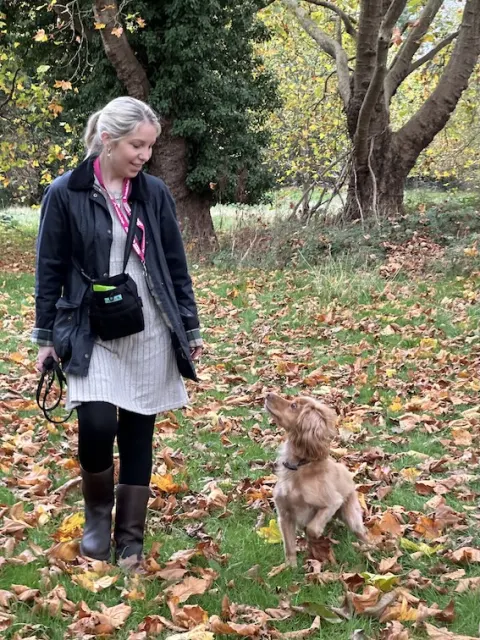
Teaching Loose Lead Walking: How I Trained Rocket to Stay Close and Calm
Loose lead walking can be a real pain point for many dog owners. It puts strain on your arms, shoulders, and back—and it isn’t healthy for your dog’s muscles or spine either. When I first started working on this with Rocket, my spaniel, I realised just how important it was to teach him that walking calmly beside me on a short lead is simply how we walk together.
Why Loose Lead Walking Was Hard for Rocket
The moment Rocket stepped outside, the world became one giant adventure. Birds, smells, people, dogs, rustling leaves—you name it, he wanted to investigate it.
Like most dogs, Rocket didn’t automatically understand that the lead had a limit or that he needed to stay within a certain distance. Pulling was his default behaviour until I showed him that staying close was not only expected, but also rewarding.
How I Taught Rocket Loose Lead Walking
Here’s exactly how I trained Rocket—step by step:
1. We began in a low-distraction environment
Before we tackled busier areas, I chose a quiet spot where Rocket could focus. I used high-value treats to keep his attention and checked whether he could even take food outside. If he couldn’t, I knew the environment was just too stimulating and we needed to make it easier.
2. We started with small, simple movements
I began by taking a few steps backwards. If Rocket followed me with a loose lead, he got a treat right away.
Then we moved forwards, and I rewarded him every couple of steps when he stayed in position beside me.
3. I changed direction often
To keep Rocket tuned in, I changed direction frequently—left, right, backwards, forwards. He quickly learned that following my movement paid off. Every time he stayed close and the lead stayed loose, he got rewarded.
4. We practised “leave it”
Teaching Rocket a solid leave it cue was a game-changer. It helped him disengage from things he might want to pull towards—like other dogs, people, or interesting smells—so he could focus on walking calmly beside me. I used this in combination with treats and praise to reinforce that ignoring distractions was a great choice.
5. I built in plenty of sniff breaks
No dog should be expected to focus nonstop, especially an enthusiastic spaniel. So we stopped regularly for sniffing sessions. I’d point to a patch of grass, say “go sniff,” and let him explore. Sniffing became one of his favourite rewards.
6. We gradually increased the challenge
As Rocket became more reliable, we slowly moved into more distracting environments. Over time I reduced the number of food rewards and used sniff breaks, praise, and simply walking together as rewards.
7. We also practised on a long line and off lead
Rocket loved practising the heel position when he had a bit more freedom. Using a long line or working safely off lead meant I could reward him with a little run or play too. It made the training fun and built a stronger connection between us.
Where Rocket Is Now
Does Rocket still get excited and pull occasionally? Yes—especially in a brand-new environment. But the difference now is that he calms quickly and remembers his boundaries. The foundation work really does pay off.
Need Help With Lead Pulling?
If you’re struggling with a dog who pulls on the lead, you don’t have to tackle it alone. I’m based in Epsom and offer one-to-one sessions to help you transform your walks into something enjoyable for both you and your dog.
Get in touch—it’s absolutely possible to teach your dog to walk calmly by your side, just like Rocket.