

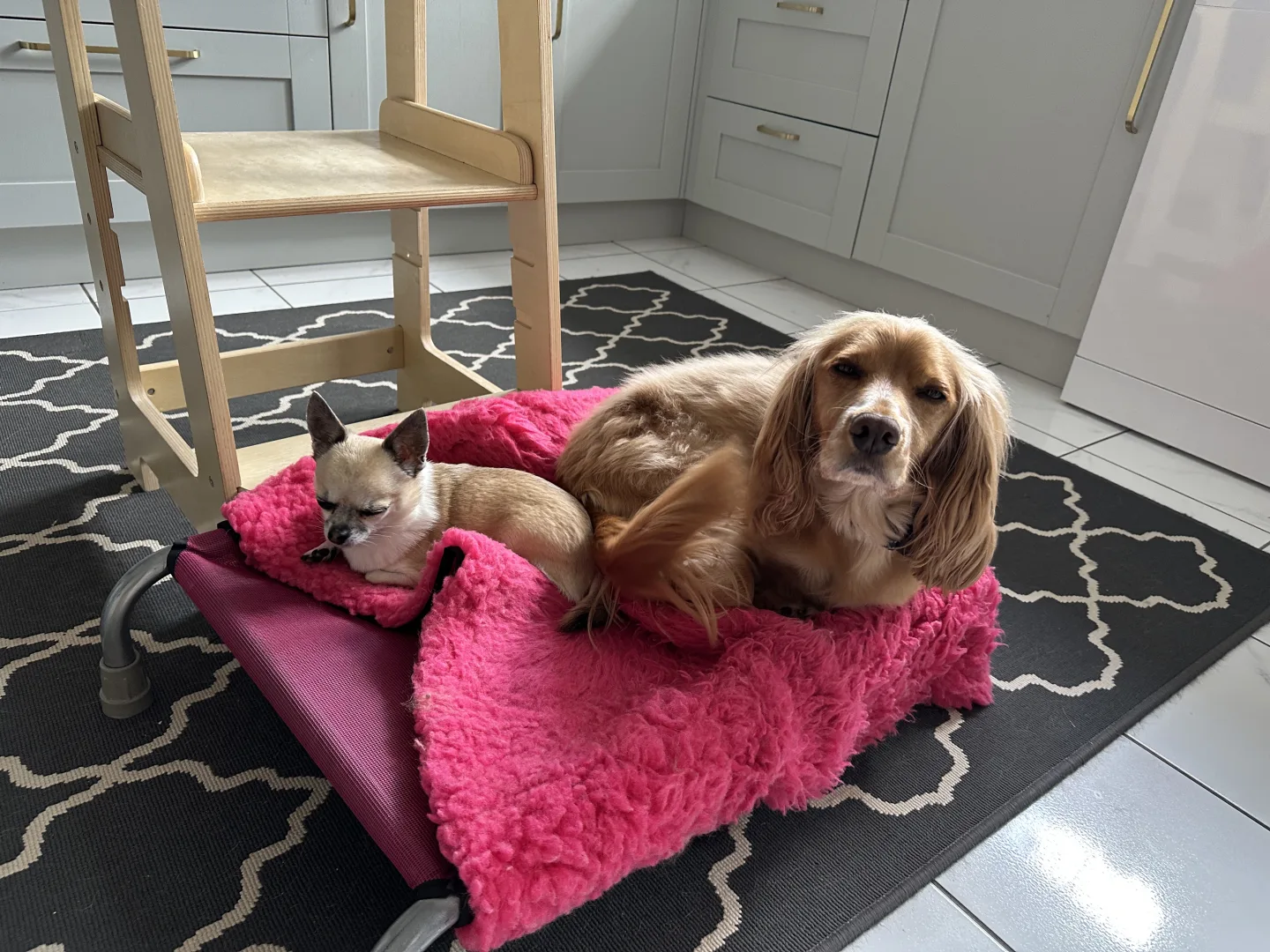
If you own a Cocker Spaniel, you’ll know the feeling: a dog that never stops. Cocker Spaniels are known for being bouncy, mouthy, and absolutely bonkers — and I say that with complete love, because my own Cocker, Rocket, was exactly the same.
As a dog trainer in Epsom, I’ve worked with dozens of Spaniels. But training my own? That was a different story entirely. Here’s what actually worked to teach Rocket an ‘off switch’ and how you can do the same.
Why Cocker Spaniels struggle to settle
- Breed traits: high energy, bred to work all day, eager to please but easily overstimulated
- The adrenaline-cortisol cycle in simple terms
- Why simply “more walks” doesn’t work
If you have a young Cocker, getting the foundations right early makes all the difference. Take a look at my puppy training in Epsom to get ahead of it.
1. Teaching a settle: “Bed = Good Things”
The first game-changer for Rocket was teaching a reliable settle.
Step 1: Settle to bed
I began by using part of his daily food allowance and placing it onto his bed to encourage him to go there and stay there. This wasn’t just about popping onto the bed and leaving again — I was already working on a little duration, rewarding him for remaining on the bed and choosing calm behaviour.
It helped him learn that staying on his bed was not only rewarding, but also a safe, relaxing place to be.
Step 2: Generalising the cue
As his understanding improved, the cue became less about the bed and more about the behaviour.
Now, “settle” means:
➡️ Settle anywhere, so long as you settle.
It was so empowering for him — and incredibly helpful for me! I’ve written a full step-by-step in my guide to teaching your dog to self-settle if you want more detail.
2. Creating predictable daily patterns
For a while, Rocket assumed every move I made meant playtime or training. Stand up? Game! Pick up a cup of tea? Training session! Walk across the room? Woohoo, let’s go!
Without realising it, all the on-and-off training and spontaneous play had turned every tiny action of mine into a cue for excitement. I was genuinely excited about training him — and Rocket could definitely tell! But that enthusiasm meant he thought we were training all the time, so I needed to change something.
So I shifted to predictable, structured patterns.
I trained and played with Rocket:
✔️ On walks
✔️ Around mealtimes
And NOT during random moments throughout the day.
This helped him understand that my movement didn’t automatically equal fun or franticness. He learned that sometimes I move around… and it’s none of his business!
3. A solid leave-it cue (for everything… including my son!)
A strong leave it cue was essential for Rocket.
Cockers are easily stimulated by noises, movement, shadows — you name it. If something happened outside the window or across the room, Rocket felt he had to get involved.
But with consistent practice, “leave it” became a cue meaning:
➡️ That’s not your job. You don’t need to deal with it.
This was especially important when my three-year-old son was playing or running around. Rocket had to learn that:
✔️ My son’s fun wasn’t his fun
✔️ He didn’t need to interfere
✔️ He could leave it and stay calm
A solid leave-it changed everything. It gave Rocket clarity and reduced his reactivity to everyday life.

4. Harnessing his natural drive (instead of fighting it)
Cockers are natural workers at heart. They thrive when they can use their nose, hunt, take on challenges, follow instructions, and even make their own decisions along the way.
So instead of trying to suppress his instincts, I channelled them.
Enrichment that worked wonders:
-
Find-it and scent games for toys or food
-
Sit-stays and impulse control games
-
Mini “jobs” on walks to give him structure and purpose
Most of this took place on walks — which meant the house became a place for calm, not chaos.
Some of these activities worked brilliantly at mealtimes too, giving him a mental outlet without over-arousing him.
You can find more of these games in my Training Library.
The transformation
Rocket is now mostly a chilled, relaxed dog in the home.
Does he sometimes need reminding? Of course — he’s still a cocker!
But compared to the whirlwind he used to be, he’s a dream to live with. The combination of predictable routines, mental stimulation, impulse control, and a clear settle cue taught him exactly what he needed:
➡️ How to turn himself off.
And once a cocker spaniel learns that?
Life gets a LOT quieter — for both of you.
If you’d like support with your high-energy dog, I’d love to help! I’m based in Epsom & Ewell and offer tailor-made one-to-one sessions to suit you and your dog.
What I wish I’d known earlier
- Common mistakes Spaniel owners make
- The difference between a tired dog and a calm dog
- How long the process takes (realistic expectations)